“Congress shall be afforded the opportunity to ban family separation by anyone who cannot spell it.”
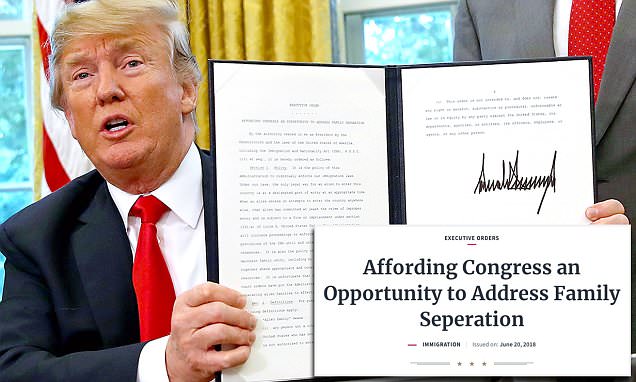
“Congress shall be afforded the opportunity to ban family separation by anyone who cannot spell it.”
My mother, a first-grade teacher her entire career, implemented the greatest inspiration/discouragement tool I’ve ever seen in education: The Yes and No Board.
It was a simple chalkboard, divided in two, with the words YES on one side, NO on the other. If a child was especially good, the youngster got his or her name emblazoned under YES. Miscreants and the mischievous went under NO.
The board was clever enough, but here was the coup de grace: Mom had the children write their own names on the board, an act of public pride or penance. Either way, it was effective: Children beamed like stars to write their name on the YES board, wept like widows at the other fate (though they always had a chance to redeem themselves with good behavior and an eraser).
Washington needs a YES and NO board.
God knows I would have Trump get as used to the NO board as Bart Simpson. From his ever-growing flock to his ever-growing need for one, Trump’s deification in the Republican base has put his ego on steroids. And his love of despots may become our fate of living under one.
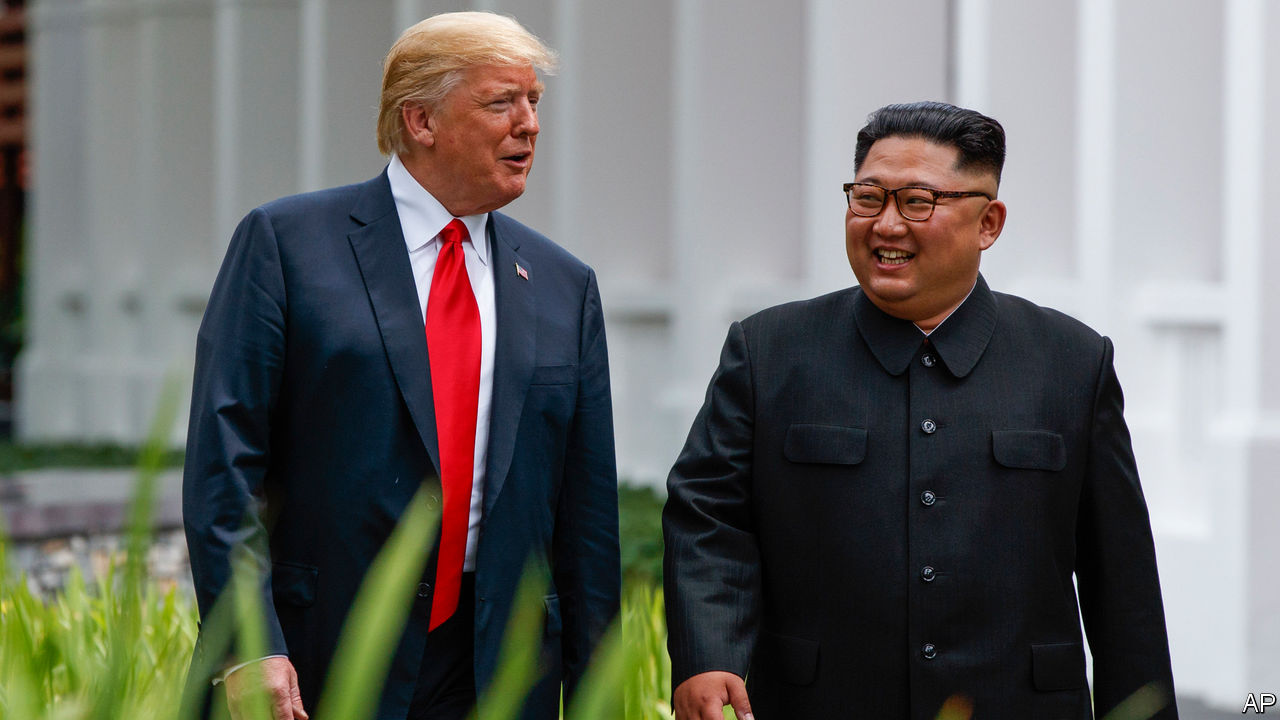
But homie deserves to write his name on the YES board for his meeting with North Korean leader Kim Jong Un this week.
I say this grudgingly. I say this with the taste of crow on my breath. I was prepared for him to tweet the nuclear code after the meeting.
Instead, we got a hugfest. A disingenuous, duplicitous globular hugfest among egomaniacs. But would we have wanted any other message coming from the confab? Perhaps them angry waddling away from each other? Trading translated barbs?
But it’s inescapable, the reticence of CNN and MSNBC to give the president credit for the meeting. And they do raise valid points: Kim played Trump like a fiddle, earning praise from the leader of the free world. The de-nuclearization process takes a decade at minimum. The letter Kim and Trump penned was, at best, vaguely optimistic. Trump’s decision to end war games in South Korea was capricious at best, an outright lie at worst.
All of which might be true. To which I say: Who cares? Who gives a shit if a nation the size of Pennsylvania wants to parade Kim’s photos with world leaders, establishing him as a peer? Who cares if the letter wasn’t specific? Did we really expect either of those pudgy lunatics to emerge with a well thought-out plan of disarmament?
The problem appears two-fold: The major outlets’ reluctance to praise anything Trumpian, lest they invoke a boycott or, worse, a decline in ratings; and a misread of the Singapore sit-down altogether.
The first is understandable. Trump invites skepticism in anything he says or does, largely because he says or does nothing. Fool me once, shame on me. Fool me 17 straight months and, well, I’ve got that coming.
It’s the second media complaint that confuses me. We keep casting Kim as a dictator of a hermit nation, which would be impossible to deny. But I was a cop reporter for 15 years, and I know a hostage stand-off when I see one. And this was a hostage stand-off.
In this case, the hostages were 60 short-, medium- and long-range missiles, including those of the inter ballistic persuasion. What is Trump going to come out and say? “Dumbo’s gotta get rid of em?” Have you ever seen a cop, trying to negotiate the release of hostages, go on the local TV news and say “That guy is a real nut job. I sure hope he doesn’t kill everybody.” You say what needs to be said til nutso puts down the gun. Isn’t that the hope for both men?
Perhaps Kim will pick it up again and fire away. Perhaps de-arming never happens. Perhaps this was all just a ruse to hack Trump’s iPhone after he left it in the toilet, which he surely did at least once.
But again, who cares? So far, there are no bodies. In any hostage stand-off, you want a lack of corpses, a dearth of gunfire and both sides talking and smiling, even if it cloaks consternation. What’s the alternative?
Donald Trump is to football what, well, Donald Trump is: out of his depth.
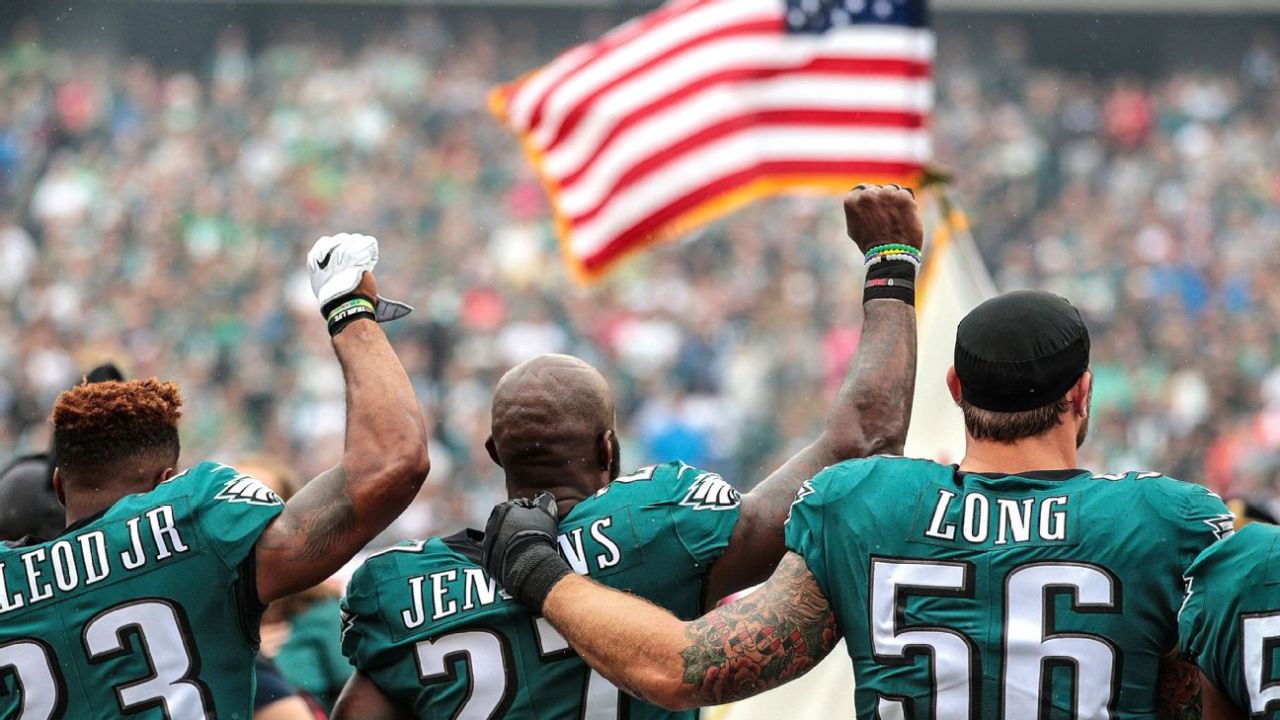
He put that on display this week when he un-invited the Super Bowl champion Philadelphia Eagles to the White House, a once-annual tradition for champions in professional football, basketball and baseball.
In depositions from NFL owners obtained by the Wall Street Journal last week, as part of a grievance case filed by former San Francisco 49ers quarterback Colin Kaepernick, Dallas Cowboys owner Jerry Jones testified the president told him in regard to the issue: “You can’t win this one.”
“This is a very winning, strong issue for me,” Jones recalled Trump saying. “Tell everybody, you can’t win this one. This one lifts me.” Like a Super Bowl-winning coach, I suppose.
But is this the hoist he expects? Certainly, Trump has managed to turn the national anthem into a political atom-splitter. While kneeling for the anthem is actually a protest of police conduct, the administration has Frankensteined it into a protest of patriotism.
Consider the wording from the bone-spurs-in-chief: “The Philadelphia Eagles Football Team was invited to the White House. Unfortunately, only a small number of players decided to come, and we canceled the event. Staying in the Locker Room for the playing of our National Anthem is as disrespectful to our country as kneeling. Sorry!”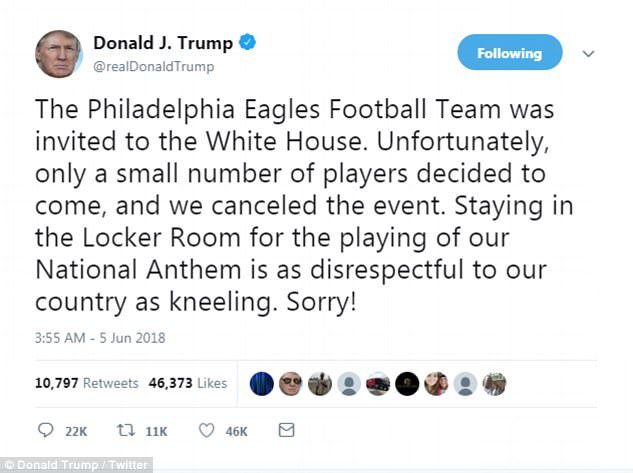
To Trump’s credit, he spelled ‘canceled’ correctly (though I would pay money to learn his capitalization code: Locker Room?). And his followers, as fervent as holy rollers, will amen the ‘I dumped him, he didn’t dump me’ stratagem.
But, as with all Trump’s words, a few need parsing and correcting. First, not a single Eagle took a knee or stood in the lOCKER rOOM for the anthem last year. Zero.
Also, Pennsylvania was a critical swing state for Trump, who beat Clinton by about 44,000 votes in ’16. Clearly, the state was split over Hillary’s viability.
One thing Pennsylvanians are not split on, however, are the Eagles. They love ’em the way Trump loves bronzer. When the city won the Super Bowl, its first, Eagles fans nearly burned down the city in victorious fervor. They tipped over police cars. They punched patrol horses. They broke off and carried traffic signs, for some reason.

And you’re going to un-invite them to their first White House recognition?
This deserves the math refresher. You won PA by 44,000 votes. Lincoln Financial Field, which hosts the Eagles, holds 69,176 spectators. And you want to piss off that many people?
Even Jerry Jones would think twice. And he’s Republican.
There are two questions that continue to ember in the wake of Roseanne Barr’s sudden disappearance from prime time TV.
One is the speed of her firing. Within hours of her tweet describing a black woman as a cross between the Muslim brotherhood and Planet of the Apes, ABC ruled she was done. Gone.
We have seen this warp-drive character melt before. Surely there is an island where people like Charlie Rose, Matt Lauer, Kevin Spacey and others must be gathered to commiserate their fates sans trials. It might even be an entertaining Survivor-esque show.
But don’t expect networks to line up for a bidding war. The assumption of guilt on matters of conduct is that latest byproduct of the steroid issue facing the U.S. economy, which has become so powerful on the Darwinian scale it has surpassed politics. That the U.S. government does not believe in global warming would be more ominous if U.S. businesses agreed. But they don’t. Donald Trump may not believe in the benefits of solar power. But Apple does. Which do you think will have a greater impact on your life?
Same with social diplomacy. American businesses have decided that it’s not affordable to offend customers. So they have contorted themselves into the least-offensive costume possible, one made of Nerf as to prevent bruising. Jemele Hill was suspended and later left ESPN for tweeting that Trump was a white supremacist. Laura Ingraham was forced to take a week’s vacation and issue an apology for a tweet offending a Parkland high school student. Alec Baldwin issued an apology and deleted his Twitter account after he publicly eviscerated a flight attendant who asked him to turn off his Words with Friends game for takeoff.

The upside is that an economy can’t afford to see race — unless that race is Mint Green. The downside is finding any nuance in that hue. For all the Sturm and Drang that followed Roseanne‘s cancellation — including a valid argument of the double standard afforded Samantha Bee — not a single major network swooped in to pick up the series. Including Fox, the most vocal critic of the cancellation. Perhaps morality extends only as far as a purse string.
Secondly, why does Twitter seemingly exist solely within the confines of complaint? You never hear of a sage tweet sent by a public personality. Or a pearl of wisdom tweeted from a politician. Instead, anger trends. Perhaps that, too, simply reflects a nation that has so much wealth but still feels swindled. Despite its P.R.-guided mission statement to give voice to the masses, Twitter is like any other media: driven by celebrity.
Which makes the recent phenomenon so befuddling. The very people taking the most heat for dumbass tweets are the people who already have a platform. The internet’s societal explosion in 2008 made the prima facie case that Americans, as a people, are dying to be heard.
And it turns out tweeting celebrities are people, too. Petty, aggravated, attention-starved people.

I had one of the most ordinary experiences of my life this month.
Like so many mundane endeavors, this one involved the government. Specifically, state government: I had to renew my driver’s license.
Previously, this had been a surprisingly headache-free process, particularly in California. I’ve had my share of motorized vehicles, and have become something of a DMV idiot savant. California had nearly perfected the bureaucracy: On some visits, the line moved more quickly than I could fill out the predicate paperwork.
Recently, though, the state “mainstreamed” the process, according to the its Pollyannic press announcement of the change. Appointments and driver’s tests could be made online, presumably to make the already-expedient process blindingly so.
But I soon realized those improvements were aspirational at best. I received the renewal notification in late March. The notice said to give myself at least a month to find an open appointment.
Wow, I thought. So much for expediency.
On, fittingly, April 1, I went online to schedule an appointment, five weeks in advance of expiration. But the earliest availability — in metro Los Angeles — was June 1. So much for mainstream. So I braced for a morning rise to try my walk-in chances. I knew the line would be long. Be prepared for a three-hour wait, I girded myself. Maybe even four.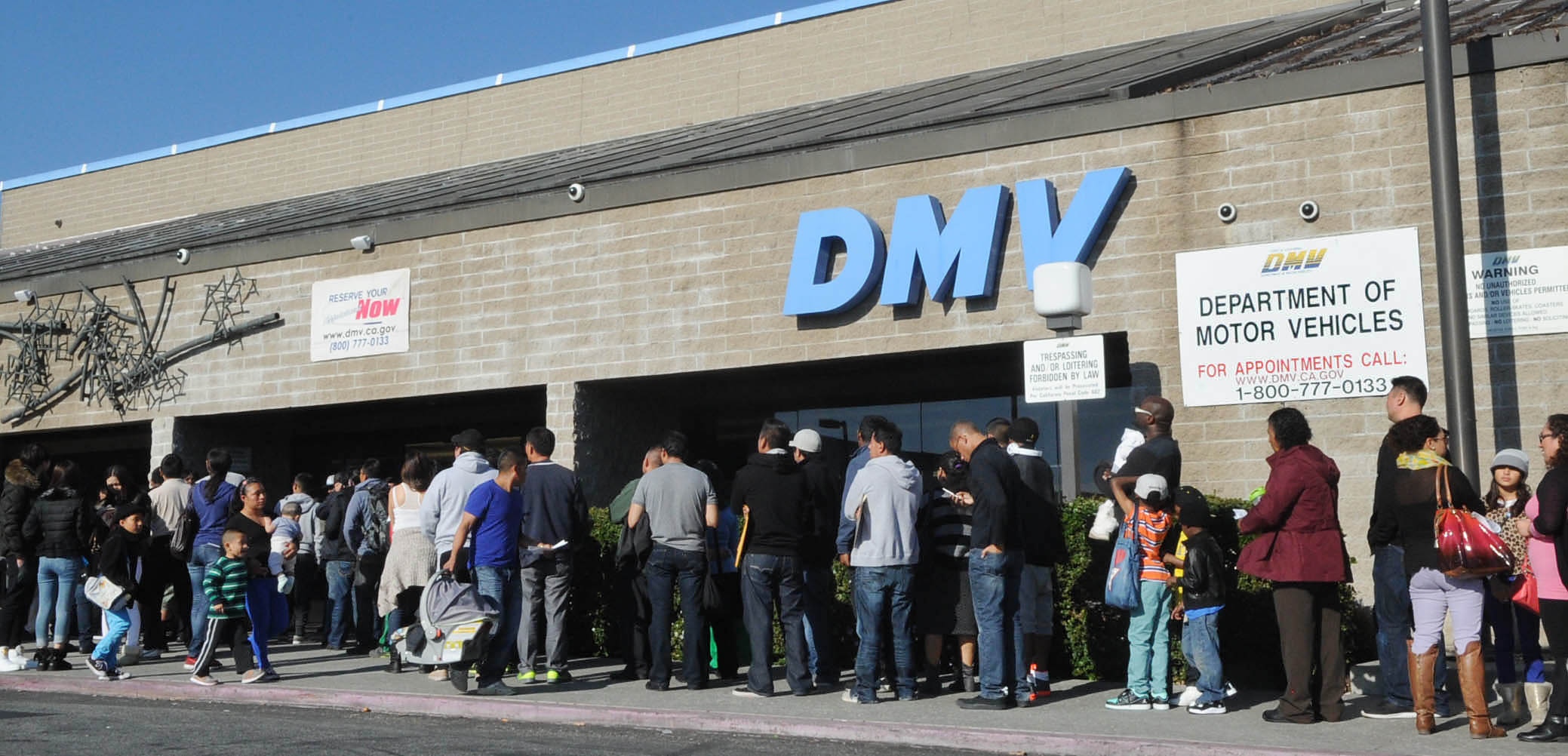
It was 6 1/2 hours.
Normally, I would have stormed out of the office by hour five in line. Fuck it, I would have thought. I’ll take the risk of a month on an expired license.
But since my father’s death and my subsequent departure from the Gnash, I’ve learned the importance of navigating stillness. Of holding onto moments, even stopped ones. Especially stopped ones. One of dad’s favorite sayings was that time moves more quickly with age, which is as true as navy blue.
Still, despite time’s seemingly inexhaustible warp drive, you can pause it. Strangle it, even. Leave it like an ant in amber: goin’ nowhere until you free it.
Sorry about that, Father Time. Mother Nature taught me a few wicked bitch slaps. In fact, she sent me to the hospital a few weeks earlier to condition my patience with a three-hour emergency room wait, followed by a two-hour gurney detainment. Emboldened by the slo-mo adventure, I decided to surprise Time at the DMV and challenge him to a bore-off.
Perhaps it was being braced for inertia (a necessity in LA traffic). Or a new outlook on time’s passage. Maybe I was high. Whatever the reason, the 6.5 hour wait — which included about .02 minutes of actual paperwork — was somehow tolerable.
In fact, I think I had the strange rush runners describe. The glacial shuffling, the dense throng of hundreds, the pent-up anger and herd-stink of the DMV, it all somehow left me giddy when I walked out. I broke into hysterical laughter on the drive home. My mother thought I’d buried the lead, starting with news of me passing the eye test instead of the wait.
That’s when I realized: I had, at least fractionally, taken baby steps in strangling time. Not only that; it’s damn simple to do.
There’s a huge caveat, of course. Some parents literally need the day to run 25 hours. Some people could use an 80-hour week to pay for things like food.
But, for the spoiled lot of the rest of us, we really don’t know how to handle time. Particularly that which is down. Our cell phones, websites, deadlines and Facetwit accounts have rendered spare time as rare as an albino alligator (a real thing that prowls southeast Louisiana).
I’ve seen the bouts of FOMO (Fear Of Missing Out), the tales of breaking free of the social media cycle, the difficulty of claiming time that is actually your own.
Good news, then. Or, as Whitman might say, “Answer.” Time need not flee you by. You can pause time. Here are five ways to strangle the moment:
Take the 7-second test. It sounds like like no time, but try a couple things that will change your mind about seven seconds.
First, after a normal inhale, hold your breath. Count to seven. Repeat the exercise on the next breath, only stop breathing halfway through the exhale and count off seven seconds again. Finally, do the same one more time, after you have exhaled. That’s it. Find a simpler meditation (suck it, Deepak!).
But admit it. Didn’t the very air you breathe taste a little sweeter on the second inhalation? Even more so on the third?
Here’s a socially braver exercise. When you’re talking to someone, either on the phone or in person, think about what they said for seven seconds. Say nothing. Just absorb what was said and weigh it before speaking. Your banter buddy will initially think something is wrong with you, the silence seemingly so interminable. But after a while, they way you’re perceived will change. You will outwardly transform from awkward to thoughtful. Do it regularly, and you will gain a reputation for being intellectual. All with a seven-second pause.
The point is, even brevity is longer than you think.
Recognize wet cement. Life is full of wet cement moments: That first minute the concrete of your mind is laid and a memory begins to dry into permanence.
We remember the big ones: births, marriages, deaths.
But what about those innumerable wet cement moments? The little recollections that fire randomly through your synapses like a lit match in a fireworks stand. A joke a child told. A revelation a friend confided in you. That weird exchange at the grocery store. Those things that are burned into your consciousness for reasons you can’t explain or understand.
But you can recognize them. Think of a positive deed you’ve done. Perhaps you helped a stranger. Rescued an animal. Gave an unsolicited compliment that left a true impression. Those are wet cement moments; little scattered gestures that make you, when the bill is tallied, what makes you a good person.
If, for instance, you’re doing the driving to take your child and her friends to their first concert, don’t think of it as a parental obligation. That’s a wet cement moment, one that she will never forget. If you see it as wet cement as well, neither will you.
Resist spackling. This one isn’t easy, but try it. When an event on your calendar is canceled, don’t fill it with another errand. You had already accounted for it, when you scheduled that meeting tomorrow so you could get your oil changed or your kid to a school trip today. What if you were to simply enjoy that hour? What if you were to people watch? Daydream? Take the 7-second test. It might not be unforgettable, but most likely it will be more memorable than a substitute chore.
Make mountains of molehills. Don’t hesitate to mentally gloat over those moments of pride — and any self-flattery you know in your heart. Your job as a professional. Your skills as a listener. Your love of animals. Your patience with stupid people. Those are attributes to which we could all aspire — and celebrate when we accomplish them, however mundane.
We’re taught not to make mountains out of molehills, advice that makes sense when you’re thinking of daunting or frightening things. But when it comes to the positive, well, fuck that. Make a big deal of maintaining your composure, or speaking openly, or listening instead of talking. Celebrate your victories of human nature, however small. For who else will recognize them, if not you? What good is a laurel if you don’t rest on it?
Reevaluate boredom. Boredom is terribly underrated. It’s a sign of utter contentment. Hungry people don’t get bored. Seriously sick people don’t get bored. People whose lives are at risk don’t get bored. There was a time when only the only people who enjoyed the fringe benefits of boredom where rich: aristocracy, castle owners, slaveholders.
Consider this statistic: Humans have been on the earth for about 200,000 years. If we consider the industrial revolution (which began in 1760) as the demarcation line between a life of modernity and having to hunt or forage for food, human beings have had the opulence of boredom for less than 1% of our time on the planet. We evolved mightily to create the fidget spinner. No need to piss on the accomplishment.
That’s it. No strenuous exercise, no change in your diet, no elective surgery. When our lifespans are measured in minutes — and everyone will face that truth one day — we won’t be measuring all the things we got done. We’ll be measuring those moments we held still, held close, until they became a part of us. Those moments we strangled.
If the average lifespan is 70 years, you get 2.2 billion seconds, or 314 million opportunities to take the 7-second test.
Better get started. Time’s not wasting, but it’s not waiting, either.
So much for the nuclear family.

It’s easy to feel we’re moving backward.
With rogue Keebler Elf Jeff Session at the legal wheel as Attorney General, it’s tempting to fret a liberal future: Our president does not believe in science and the Supreme Court is shaded red by a robe. Evangelical citizens have have the right to deny business services to those they deem sinners. White nationalism is on the rise, both in number and volume (and tiki torch sales).
It’s enough to send progressives into apoplectic shock.
But fear not, liberals: History has always been on your side. It was true 5,000 years ago, and it’s true now.
Consider the latest shift off the political port bow, the federal legalization of gambling. Earlier this month, The U.S. Supreme Court — Donald Trump’s Supreme Court — legalized sports betting in every state. The ruling came after New Jersey, seeing the tax money Nevada raked in annually, filed a legal appeal insisting on a piece of the action. And they won it.
Had, say, Hillary Clinton been in office when gambling was legalized, the religious right would surely be spastic with anger. But with a president and Congress dominated by a dunce confederacy, what could they say?
The real failure lays at the feet of CNN and MSNBC, which woefully underplayed the ruling. Perhaps they didn’t see it as coverage-worthy in a storm of news currents. Maybe they’re not sports fans. What’s more likely, however, is that because the ruling benefits business — and earned nary a peep of ire from the right — left-leaning opponents did not see it as a victory.
But it is. A big one.
Consider what the U.S. Supreme Court, following states’ leads, have legalized in just the past three years:
And that doesn’t include ancient liberal victories, including the defeat of prohibition, the Civil Rights Voting Act and the suffragette movement. There are 21 brothels in Nevada, where prostitution was legalized in 1971. If you told a Democrat in 2015 that the country would legalize gambling, drugs and gay marriage, you’d get an embossed invitation to the loony bin. And certainly, Trump’s disdain for America and its poorer denizens sometimes make the victories feel Pyrrhic at best.
But in truth, history has always arced left, thanks to the surge in technology and reason. Consider what used to be legal:
The list is endless, but irrefutable. We have reduced the major religions in the world to three. We no longer attribute epilepsy to demonic possession. Voter suppression remains alive and well, but not publicly tolerable. Remember: Jim Crow laws were once written directly into state constitutions. Here was Louisiana’s former test to vote (you had to prove at least a 5th grade education for access to the ballot box): 
And it’s hardly just an American boat that’s listing left: Global warming is recognized by the U.N.; Saudi Arabia approved female drivers; Afghanistan has the internet.
Even religious front lines are softening. Erlier this month Pope Francis told an Italian newspaper that “the souls of those who are unrepentant, and thus cannot be forgiven, disappear” upon death and that “hell does not exist; the disappearance of sinful souls exists.” A week later, he followed that with this bombshell attributed to a homosexual Chilean man: “That you are gay does not matter. God made you like this and loves you like this and I don’t care. The pope loves you like this. You have to be happy with who you are.” Catholics nearly declared a fatwa on the man for that one.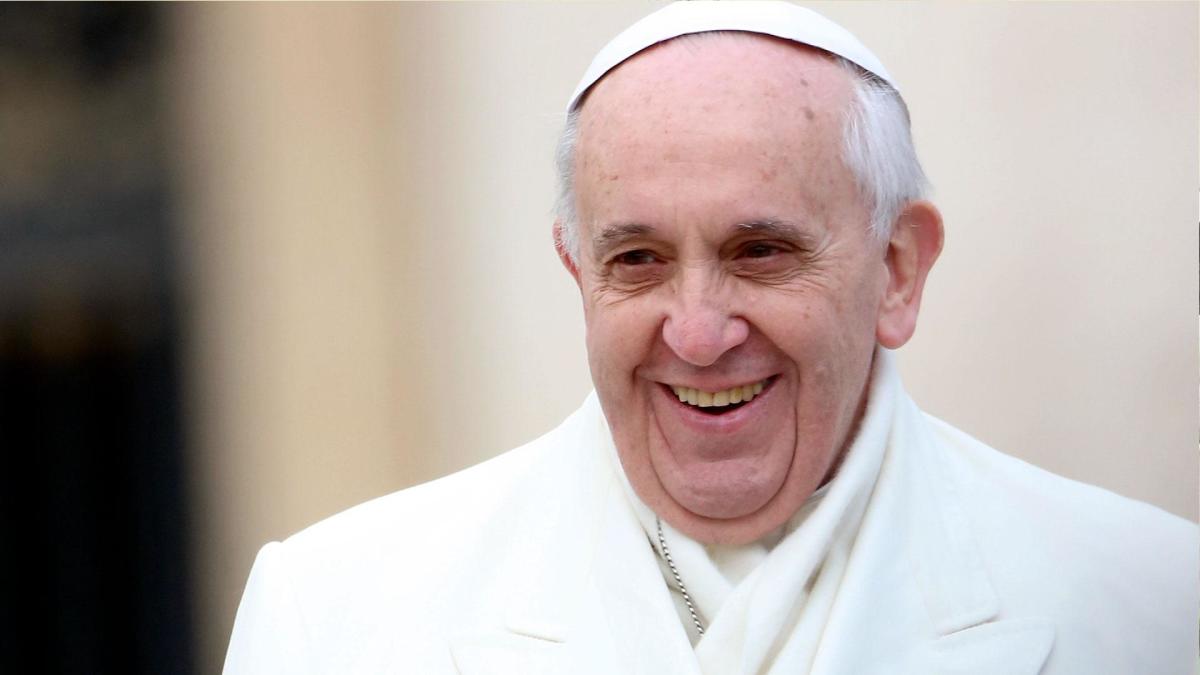
This shouldn’t suggest we’re anywhere near where we should be on the sociological map. And it doesn’t help having a president who doesn’t know how to work one.
But you need not be a history major to see the larger trajectory. Simply a recollection of value shifts within your lifetime likely reveal the direction we’re moving.
Up.

The NBA playoffs began this weekend, as did the requisite hype about gravity-resistant superstars and dynastic empires rising and falling, all of which are true.
But the best story of the 2017-18 basketball stories has already been told. And it has nothing to do with the playoffs.
If anything, it has more to do with the anti-playoffs. Of falling short. Of rejection, failure and futile energy. And of Andre Ingram.
Ingram is a case study in frustration. Lanky, six-foot-three and of middling strength and speed, Ingram managed to get a basketball scholarship at American University, a small college in DC.

He had a respectable-if-forgettable career there, averaging 14 points a game at the tiny college. He had hoped to go pro as we hope to get the job we dream of, find the love that completes us, fill the gap that only we can. And, as happens to so many of us, reality pimp-slapped us a bit.
Ingram managed to land a spot on a team in the NBA’s G-League, the sport’s minor league farm club system. There, injured pros go to recover. High school phenoms are groomed by veterans. And players like Ingram eke a living to the tune of about $19,000 a year (the average American income is $27,000 a year, according to the US Census Bureau).
But while the G-League does a heckuva job with metrics like points-per-game, 3-point shooting accuracy and turnover-to-assist ratios, it has no barometer for internal organs — namely, the heart and brain. And Ingram has both.
While he toiled in the minors, Ingram — who earned a degree in physics from American, for Chrissake — supplemented his income by being a math tutor. After all, hoop dreams can’t afford Cheerios for two kids and a wife, all of whom joined the Ingram brood. For 11 years, he played in the echo chamber of gymnasiums that barely muster fan smatterings. The G-League is the GM of pro basketball.
But he did something quietly remarkable on the assembly line. He gave a shit. He earned the coy dollars that came his way. He did what We do on the line: Make sure the bolt is tight.
And while he’d never be featured on ESPN or Sports Illustrated, he became something rarer than a superstar. He became a Remarkable Joe. Ingram took what he learned in college and became a better adult. He’d earn a reputation as a man who busted ass in the journeyman circuit that took him to spots in Utah, Oklahoma and, finally, California. He’d shoot more than 700 3-pointers, the league record. He’d go from 14 points a game in college to 22 a night.
And last week, he got a call from his employer for an exit interview at season’s end — a performance evaluation for the rest of us.
But instead of meeting with human resources this time, Ingram was greeted by Magic Johnson, the general manager of the Los Angeles Lakers and local god to this city. And Luke Walton, Laker coach. And TV cameras. And a miracle: An offer to play the final two games of the season in the NBA.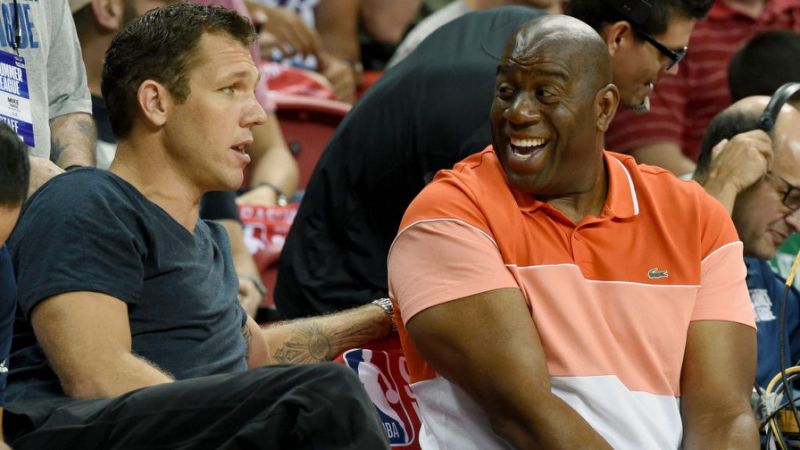
He’d be offered $14,000 for two games — 75% of his annual salary. He’d be in an arena with actual people. He’d be playing against the Lebrons of the world. He might even catch a glimpse of himself on ESPN, management told him, though they’d need not have worried about making the sale. As he’d done all his life, Ingram recognized Fortuna.
His debut came against the Houston Rockets, the favorites of many to win the title. He’d go up against James Harden, the league’s likely MVP. As Harden sauntered into Staples Arena sporting his trademark Beats headphones and throngs of reporters and fans, Ingram walked unnoticed among fans wearing a school backpack and holding the hands of his wife and kids.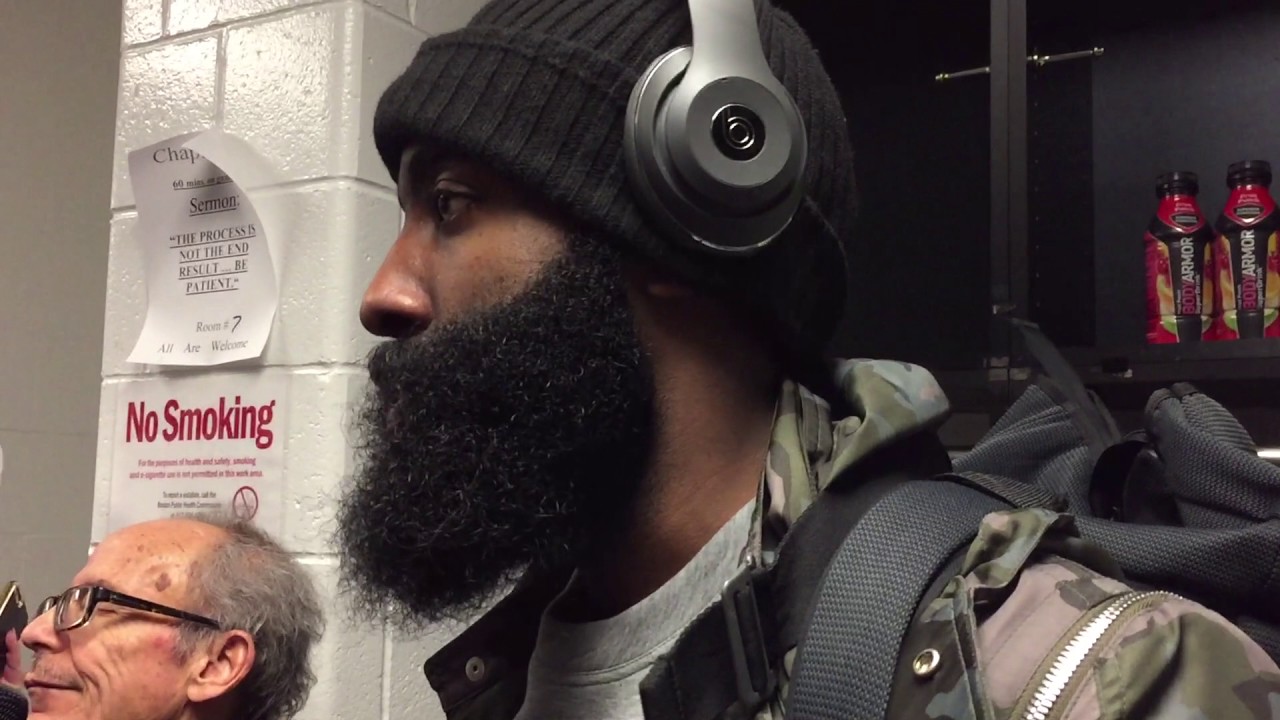
On court, he was easy to spot. He was the only 32-year-old rookie — and the only player with a healthy dollup of gray hair. His team, like every other in the NBA, was fated to lose that game.
But not before Ingram punched his time card.
Ingram scored 19 points. He went six-for-eight, a terrific percentage, on his shots. He went four-for-five on his three pointers.
And for one beautifully-strangled minute in time, Ingram was Lebron. Fans stood for him and shouted “MVP!” Stars tweeted about him. For a day, he held the Lakers best points-per-minute average. The team had to manufacture replicas of his jersey to meet customer demand.
Now, the NBA will pay attention in tryouts. Stars will look up his pre-season stats. ESPN will do a half dozen stories about his games. Fans will ask for photographs. He will be heard from again.
You are Andre. We are Andre. And when we aren’t feeling like him, we can still learn from him, because his life sermon is Waterford clear:
When Life gives you lemons, don’t make lemonade. Pick up the lemons and chuck them back as hard you can. Aim for the nuts. Aim for the face. Slice it with your thumbnail a little before you chuck it, so it gets in Life’s eye.
Fuck fate. It never had an outside jumper anyway.
My mom tried to skateboard once.
Well, “tried” might be a generous term. So might “skateboard.”
In truth, she stepped on the board the way someone would step on a sidewalk crack. We were living in Detroit, she saw me rolling up and down the drive, and thought, I presume, “How difficult can it be if a 10-year-old can do it?”
But when mom stepped up, the board skittered out from under her, rolling down the driveway and landing mom square on her ass. She hobbled into the house, probably cursing kids today, and never got on a board again. But she also likely never forgot: Set, then go. Set, then go.
The same can’t be said for Laura Ingraham and her SS comrades at Fox News, a network that’s adopting the same mystifying politicking strategy as the GOP: attack a demographic.
She began with Dreamers, who she said should be in front of the firing squad for DACA’s failures. Then she took aim at Parkland survivors, who she said had neither the experience nor maturity to discuss adult matters (like guns and DACA?). Then, perhaps intoxicated by free-range chickenshittery, she hammered one of the Parkland kids on Twitter for his rejection from several colleges.
“David Hogg Rejected By Four Colleges To Which He Applied and whines about it. (Dinged by UCLA with a 4.1 GPA…totally predictable given acceptance rates),” she keystroke-belched.
Aside from her capitalization problem, the attack was a stumper. Normally, Fox and Fiends go after races and genders. Why would anyone think it prudent to take a bead on a demographic — that’s about to come of legal age, no less? Are we really taunting kids over rejection letters? Is this the swamp or the drain?
It suggests a larger dilemma for the GOP, which finds itself on the wrong side of the three big G’s of politics: god, gays and guns. Millennials already constitute the highest percentage of atheists in American history. What high schooler does not know a gay or transgender classmate? And we know how they feel about AR-15s; the gun debate is over, even if the legal wrangling is not. There’s a reason a Republican presidential candidate hasn’t won the popular vote in an election since 2004: They’re not popular.
Kids like popular. And first impressions matter.
And finally, to Miss Ingraham, who has proved a fine substitute anus for the departed Bill O’Reilly (Tucker Carlson was a ratings disappointment, perhaps because he looks like he’s always trying to stifle a fart).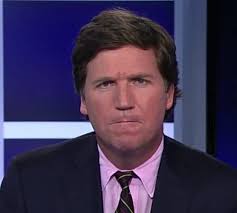
She had softened her tone by Saturday afternoon, tweeting “Any student should be proud of a 4.2 GPA —incl. @DavidHogg111. On reflection, in the spirit of Holy Week, I apologize for any upset or hurt my tweet caused him or any of the brave victims of Parkland.”
But there’s no saving the crow you had to eat. In response to Ingraham’s first insult, Hogg did something slyly brilliant: He tweeted links to Ingraham’s dozen sponsors, nine of whom pulled the financial plug. The sponsors may eventually return, but Parkland again schooled adults on mature behavior.
And fucking with the wrong people. Coming after kids on Twitter is like challenging a Comic-Con fanboy to a Star Wars trivia contest. When mom took that spill, she did what kids are waiting for other adults to do: act like one. She was done with boarding, but she wasn’t about to ban it. Nor was she going to grab it to challenge Tony Hawk to an X-Games skate-off.
Laura: Set, then go. Set, then go.
Away.
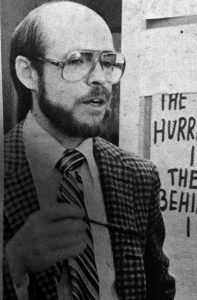
A speech I was supposed to give Friday for Mr. Button, my high school journalism instructor and personal hero.
First off, an apology to Mr. Button and my Blue Devil brethren: Mr. Button, I could no more call you “Bob” than I could call my father “Billy.” So please excuse excuse the New York Times formality.
It seems fitting that The Tower‘s 90th birthday falls during March Madness, when school frenzy is frothing.
I try to avoid too many alma mater boast-offs come this time — and not just because my college hasn’t mustered a respectable sports team in a quarter-century. It’s just impossible to quantify adoration.
Still, if there’s no way around a rabid school chest-thumper, I always have the nuclear option: The Mr. Button Button.
It goes something like this: Somewhere mid-bray, I’ll ask the alum if his school had a newspaper.
Why of course! tended the typical, immediate response. Why, they note, it even came out weekly, sometimes daily!
Then I push the button. “Did your paper have tryouts? How about cuts if you didn’t make the staff?”
Then the hesitation. That’s when I’d drop the story about Mr. Button, who was inducted into the Michigan Journalism Hall of Fame in the late-80’s. If you wanted to study journalism with Mr. Button, you took the introductory course — and, as a final, submitted a thesis-like paper; either with a story you generated yourself or an entire hand-designed paper to demonstrate news judgment.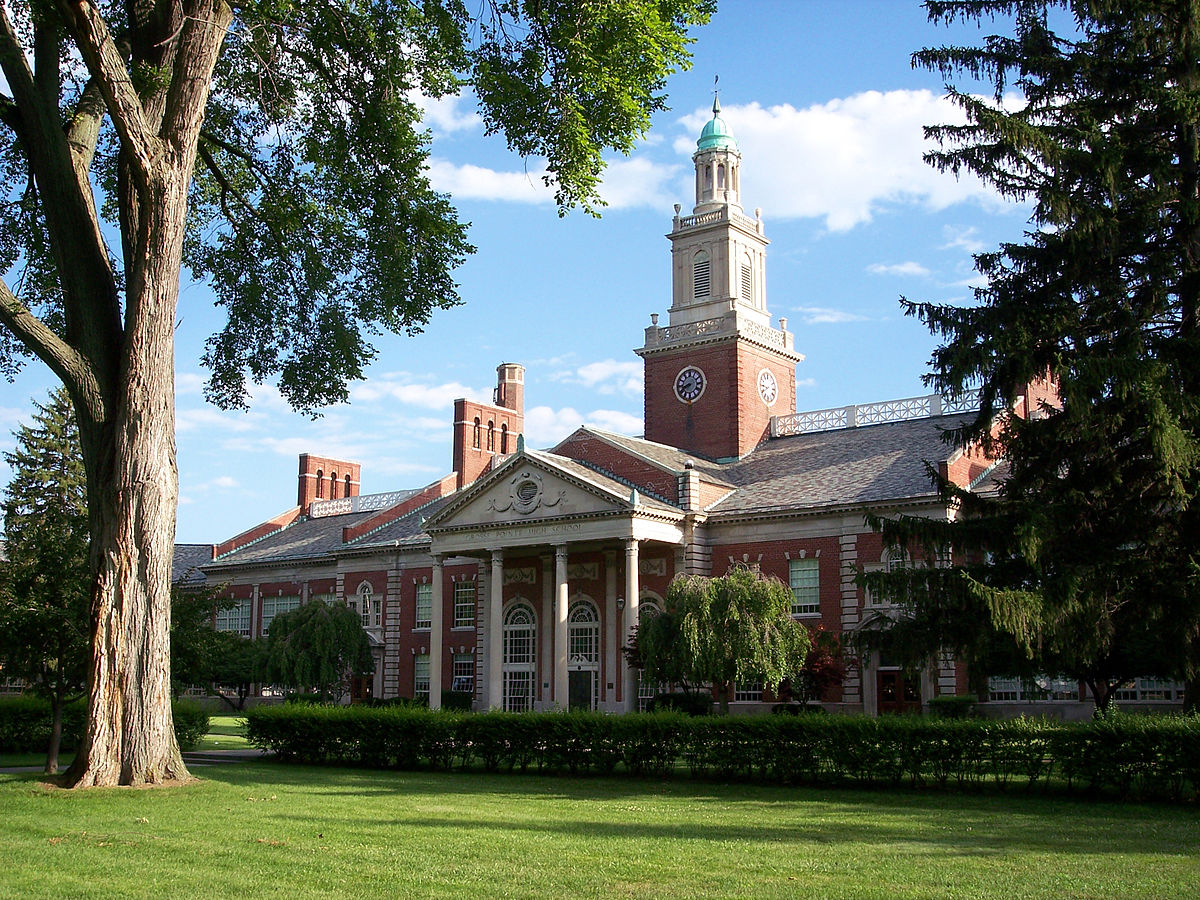
If you passed, you made it on The Tower, the school’s national award-winning paper (Mr. Button was once congratulated in 1966 for taking the helm of The New York Times of high school papers. Personally, that sounds like a bit of a dig (The Times doesn’t have tryouts and cuts). If you didn’t pass, you’d spend your next year writing for The Grosse Pointe News, the local weekly newspaper.
Imagine that. That’s a little like trying out for the varsity football team and, if you were cut, having to play for The Detroit Lions.
Yet, as kids, we never marveled at that. That was simply how Mr. Button ran shop: As a serious paper, covering news that students, teachers, parents and even shop owners read religiously. The school had its own mini-staff to sell ads. We’d write editorials challenging the school administration. We’d pan lousy plays.
We were a newspaper, as dedicated as any of those that employed me.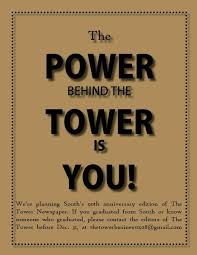
And that, too, was Mr. Button. I’d be hard-pressed to recite a specific lesson I took from Mr. Button (the only journalism classes I have ever attended).
But I can tell you the theme that underpinned every lesson: Never fear the truth, no matter where it leads.
And now the truth leads us here.
I know you will be awash in hugs, handshakes and memories of halcyon days too many to count. But let me add one.
After college, I took a job at The Arkansas Gazette. One day, I received a call from Neal Shine at The Detroit Free Press, the pope of Detroit journalism. (And father of Dan, who preceded me at The Tower.) Neal told me that you were being inducted into the Journalism Hall of Fame, and he was collecting quotes for a column.
I’m sure I bored him with plaudits. But for years, the core of Neal’s question — What made Mr. Button such a good teacher? — gnawed at me. Until a week before this gathering, actually. I went through old Towers. I went through old memories. I went through 35 years as your psychological apprentice.
And finally, like an anvil about to brain Wile. E. Coyote, it dawned on me.
Schools aren’t to learn something. They’re not even meant to teach something, this event notwithstanding.
They’re meant to set something on fire. To light an internal hearth that burns well past school, well past adulthood, well past our brains and into our hearts. For what are we, other than than bundles of kindling and curiosity, waiting to be set ablaze?
As you look around you tonight, I hope your impact is diamond clear. The people who keep coming up aren’t former students. They’re not alums. They’re not even former Tower reporters.
They are embers, still burning from the lessons you taught, from the passion we absorbed. I can attest: You have spawned a legion of terrific writers. I can also attest: You have spawned the parents of terrific writers of their own.
Mr. Button, thank you for being a master arsonist. We are better for the glow.
 The Hollywood Bowles