The Hollywood Bowles

Those who can't write, edit. Those who can't edit, blog.


Hey Sam,

Happy Birthday! Well, ours, at least.

It was 17 years ago today we met, shortly after your motorcycle accident.

I can’t tell you how sad your mom was then, or how tough it was deciding to have your organs harvested. She argued with your dad over it. But her years as a nurse in a hospital burn unit convinced her to have you help save my life.

Which you did. As did she. And I think about you both every day, particularly around this time of year.

How is life in the cloud circuit? If he hasn’t already found you, be on the lookout for my dad. After the transplant, he found out how you died — and lived. Even went to your house in Fargo simply to see the home that housed the saviors of his son.

Big guy. Salt and pepper hair. Always losing his glasses. Probably punched the boss simply for being a goddamned phony. 

And please keep an eye out for my dog, Teddy. He traveled North last year. 

You can adopt him if you like. I know you’re as crazy about dogs as I. You’d love him. He truly wouldn’t know a mean bone if he were conked on the head with it. Tell him Esme misses him terribly. 

But be aware: He’ll eat your wallet. And if you have to curb your dog in heaven, you’re gonna need a couple bags for the poop during walks.

Well, that’s it from points South. I wasn’t really sure what to get you for our birthday. But I think I found just the present.

My beating heart.


From WDET Detroit Public Radio December 8:

Does giving something a name give it power? That’s what WDET wondered in the latest episode of its podcast Created Equal. It examined the origins of a crime first identified in the Motor City: carjacking.

The term was invented in 1991 after Detroit News crime reporter Scott Bowles noticed a recurring initialism showing up on the daily crime reports; RAUDAA, which stands for Robbery, Armed, Unauthorized Driving Away of an Automobile.

Bowles and his editors decided to do a project on this specific crime. They found dozens of instances all over the city of people being pulled out of their cars by armed criminals. But before they had a story, they had to improve on the name. RAUDAA wasn’t catchy enough. They tried several options before settling on carjacking. Soon, the term was everywhere.

“A few days later, Ted Koppel used the word ‘carjacking’. And that was it.” Bowles told Created Equal. “When the feds made it a federal crime … now you see it everywhere.”

Carjacking became another threat to people living in or visiting the city. The invention of the term may have even lead to a temporary spike in the crime. Detroit police recommended drivers roll through red lights if they felt unsafe, a practice that continues to this day. Decades later, Detroit is still known for carjackings. In 2013, Detroit Police Chief James Craig managed to escape a carjacking when someone attempted to take his unmarked police car on one of the city’s main thoroughfares. In 2014, the Associated Press dubbed Detroit ‘Carjack City’. Last year, there were 532 carjackings in Detroit.

The story of how carjacking turned from a local phenomenon to a federal crime is fascinating and WDET plunges into the subject in detail. You can listen to the podcast here.


The election is over, if zombies ever die.

Turns out, the atheists were right, though Darwin was mistaken.

And the end may be nigh. But at least it will also be hilarious, as witnessed by these mock phone calls from the Donald to his new BFF, Barack.

1 On Presidential Medals Of Honor And Kazakhstan

2 On Gifts, Candy And The Mexican Border

3 On The Nuclear Codes, Iran And Jackie Chan

4 On Taiwan And The State Of The Union Address

5 On Time’s ‘Person Of The Year’ And The Mexican Wall

xxx

xxxx


I have been a police reporter for 15 years, and a film reporter for another decade.

So I feel comfortable committing the following double heresy:

All the President’s Men is a lousy movie.

As a book, it’s poetry. As a story, it’s the gold standard for every aspiring reporter.

But, strictly from an entertainment perspective, the 1976 Oscar winner for Best Picture — and five other Academy Awards —  cinematically sucks.

I realized this last month, when HBO — perhaps in a plea for substantial political journalism — made it one of their feature films for the week spanning Election Day.

At least a dozen times, the movie has unspooled before me. I know the story, the characters and the circumstances inside out. I even recognized the lobby, newsroom and parking lot, as The Washington Post was my old employer, Bob Woodward my Sunday editor.

So on my most recent viewing, I decided to watch again. This time with intensified focus. Even played it with closed captioning, to absorb the nuance of the script.

No matter. It still blows.

For one, there are simply too many characters to follow. Just try keeping up with the names of more than three dozen actors with screen credits, from political wonks to Post editors. Unless you’re a journalism major in college, you likely don’t know the name Harry Rosenfeld (He was the Post’s city editor an a key figure in the scandal.). By the second hour, you need a score card and flow chart to keep track of the characters.

Second: we never meet the mysterious character behind the film, Deep Throat. The real life character, Robert Felt, was only identified posthumously.

Now imagine trying this strategy in any other film. Consider the pitch:
Producer: “So we’ve got this shadowy figure, who only meets Robert Redford in darkened garages after secretly signaling him he has found new evidence.”
Exec: “I love it. Who does it turn out to be?
Producer: “We don’t know, so we never reveal.”
Exec: “The door is that way.”

Or another scene, in which Carl Bernstein confirms his story with a source over the phone.
Producer: “It’s even got a 10-second countdown. Or count-up — the reporter is counting to ten.”
Exec: “Beautiful. What happens at 10?”
Producer: “Nothing. He confirms the story by not hanging up.”
Click

One thing it does get right: the acrobatics required to handle a telephone while trying to write down what people say. How many collective hours, I wonder, were wasted in old films of characters dialing a rotary phone?

phones

It’s easy to see why APM was an unmitigated success. For the public, it was a reminder of what a healthy press looks like in action. And they could drool over Redford.

For critics, Alan Paluka’s drama took painstaking measures to get the details right, and it did (however stultifying those details were). Good films raise the art of its subject matter.

And who in the mainstream press was going to knock it? Sure, the meetings between Deep Throat and Woodward were pure fiction. But when’s the last time reporters were portrayed by acting icons? Hollywood characterizations of reporters is typically  negative when the journalist is a minor character. But positive when they are central characters.

Finally (spoiler alert): the finale. APM concludes with no arrest, no showdown of powers. Simply a teletype, clacking the news that Richard Nixon resigned from office. Roll credits.

It was a wholly appropriate finale, one that perhaps was as spot-on as any based-on-a-true-story premise.

But ending a narrative with a few lines of text rarely makes for compelling drama.

See?

To miss a train or business deal,
Because our clocks are without keel
Can cause a nation loss of gold
E’en worse than all the misers hold.

— 1942 letter to Time magazine urging a national daylight savings time


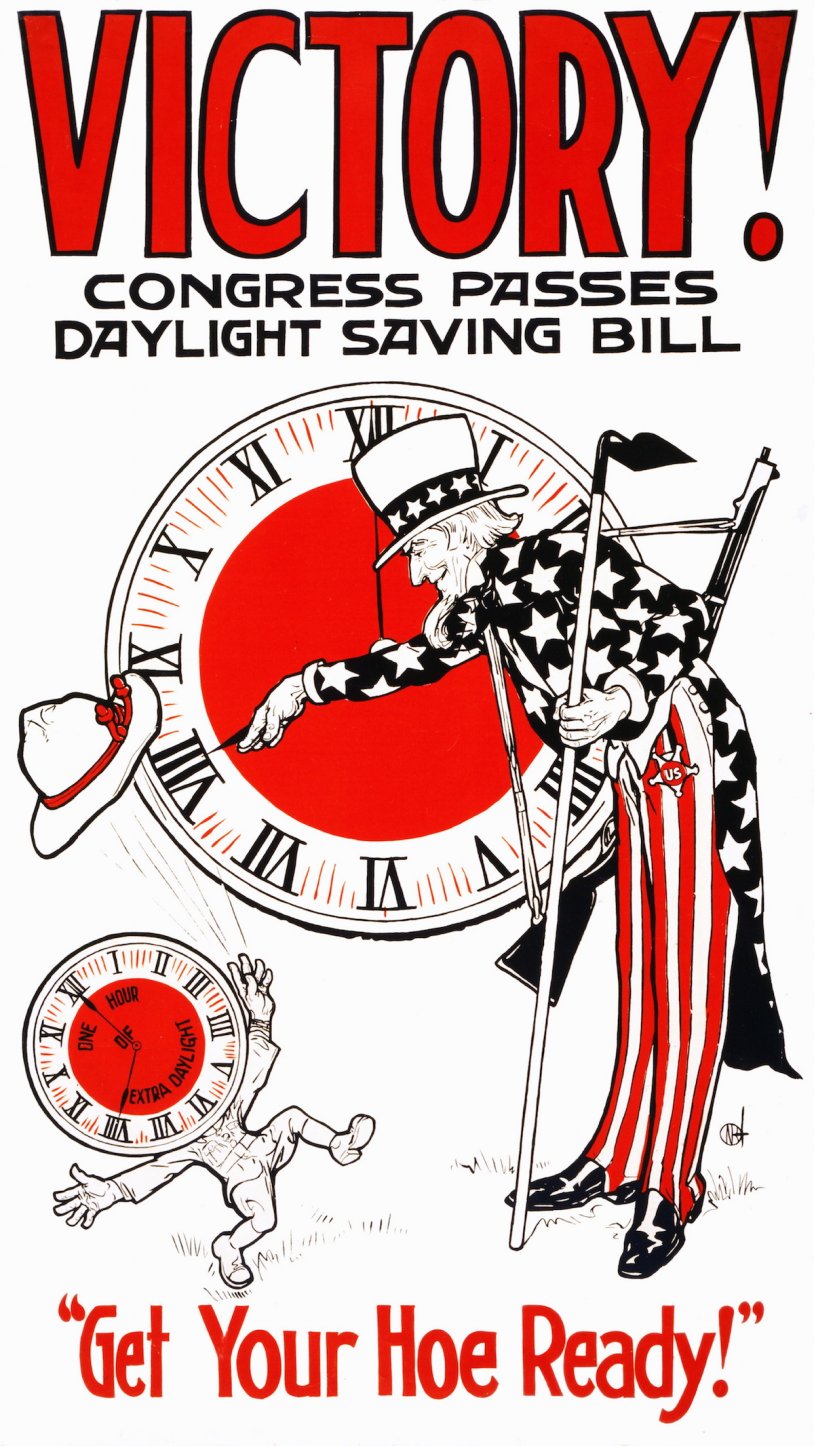
One of the few undeniable benefits of living in the digital era is not having to walk through your home, manually turning back or twisting forward by an hour all of your clocks and watches. Smartphones, computers and even DVRs automatically align with society’s circadian rhythm , as dictated by the nation’s Daylight Savings Time law.

Yes, it’s a law, signed in 1964 by Lyndon Johnson.

But we’ve been screwing with clocks long before then. Sunday morning will mark exactly the 100th time the U.S. has either sprung forward or fallen back. Indeed, we’ve been doing it for so long we’ve forgotten why we did it in the first place — or why we continue to do it.

Daylight savings was initially a wartime maneuver. Germany was the first country to implement it, calculating that the Weimer Republic would save thousands in electricity costs by maximizing daylight hours. Turns out, despite schoolyard legend, that it wasn’t because of stupid farmers.

In fact, farmers hated the change. It meant that, for half a year, they had to get up earlier to bring milk and harvested crops to market. Hollywood hated it, too, reasoning that people were less likely to go into a darkened theater while the sun was shining.

But Uncle Sam would have none of it. If Germany could figure out a military advantage using only a pocket watch, surely we could too. And it didn’t hurt that some institutions — like Major League Baseball, which had not yet invented stadium lighting — tacitly lobbied Congress to institute the shift.

Never mind the grim statistics that come as surely as a beach tide during daylight savings. The National Highway Traffic Safety Administration says that accidents spike fractionally twice a year — the weekend and first week of daylight savings — due to fatigue and drowsy driving.

clock

And there’s no evidence supporting an energy savings. When Indiana adopted the law (you can opt out as a state, though only Arizona and Hawaii have done so), electricity use actually rose 1%. Small, but with a population of 6.5 million, significant.

Still, don’t expect anything resembling change. After all, this is a Congress that still supports an electoral college, though I challenge a single lawmaker to explain why it still exists.

So for now, we’ll just have to get used to it. And, as a public service, remember to adjust your clocks at 2 a.m. Sunday. Remember, it’s the law.

Speaking of which, how about at least an amendment to the bill? Instead of messing with the time-space continuum at 2 a.m. on a Sunday, why not have spring’s leap forward at 4 p.m. Friday? And its  fall backward at 9 a.m. Monday? You know, so we can at least spend a couple hours less in a cubicle.

That would at least keep us clearer-headed on Tuesday’s election day.

Speaking of which (encore); ever wonder why our presidential elections are held on a Tuesday? Congress chose the day because voting booths were once rare and separated by hundreds of miles. Many voters had to spend Monday simply traveling to make it to the polls in time. And we’ve never modernized.

Stupid farmers.

'Daylight Savings Time claims another victim.'

‘Daylight Savings Time claims another victim.’


I’ve never really had an issue with clowns.

Krusty is one of my favorite Simpsons characters.

The Joker is my favorite villain from the realm of superheroes (I even have a Halloween mask from The Dark Knight). knight-clown

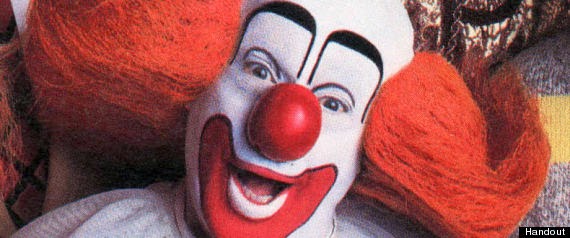
As a boy, I was one of Bozo‘s faithful TV servants (along with Bozo’s magician sidekick, Marshall Brodien, whose products I would consume like a meth addict). I once wrote the show requesting tickets, only to be told there was a two-year waiting list.

marshall

I couldn’t wait two years. I had to go to college.

But I knew clown aversion was real. My ex brother-in-law was so creeped out by them he would visibly shiver if you brought up the issue.

Still, I had no idea how pervasive it was until I began reading about the “creepy clown” craze sweeping the nation. Apparently, dressing up like a clown and trying to freak out children (and the childlike) has become a thing.

According to the New York Times, more than a dozen people have been arrested for clowning. Children in Ohio and Texas have been charged with making clown-related threats to school classmates. A New York City teen told police a clown threatened him with a knife in the subway. In Wisconsin, a couple was arrested after police discovered they’d left their 4-year-old child home alone while they went clowning. A Seattle-area high school was shut down after  some students reported seeing costumed figures in the woods.

But the prize goes to Mississippi, which reacted as if evolution were being taught in its classrooms. Supervisors in Kemper County passed a bill that bans people from wearing any clown costume, mask or makeup in public. The local law carries a $150 penalty, and it will be lifted Nov. 1.

You know, after Satan’s favorite holiday.

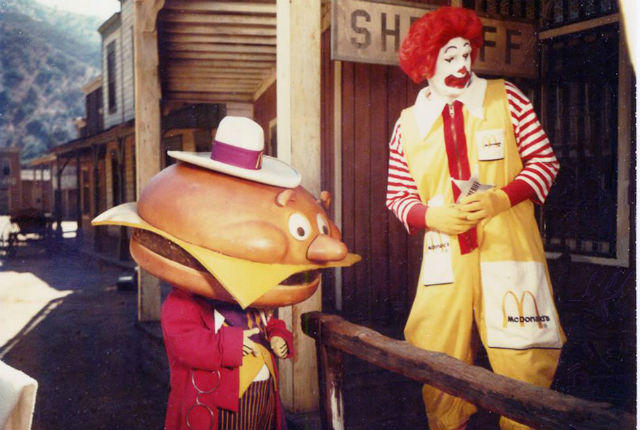
Which raises a few questions. What is the criminal charge for circus wear? Do they have to wear said getup in a police lineup? Does Ronald McDonald have to turn himself in to Mayor McCheese?ronald-and-mayor

If you fear being a victim of clownism, there’s reason for hope. Halloween is just around the corner, and the shelf life of fads in the social media time-space continuum can be measured with a stopwatch, not a calendar.

Unless, of course, we find lurking in our woods the most frightening of the orange-haired menaces.

trump-clown


There’s an idiom in contemporary politics that goes, approximately, like this: Republicans wake up angry; Democrats wake up sad.

It would seem an inescapable truism, particularly given the rancor that freights this presidential campaign. While it will go largely unnoticed, Mike Pence did something extraordinary Sunday: He promised the nation that his party would peacefully accept the results of the election.

Think about that. Simply as principle, Democracy relies on an assumption that those involved understand the rules of engagement. Rules that weren’t in question say, during the presidential primaries, which were similarly rife with vitriol.

But in watching Pence, I realized that some Republicans must be waking up sad, too.  They also see where this path inevitably leads: To self-cannibalization.

Michael "Mike" Pence, governor of Indiana, pauses during an interview in New York, U.S., on Thursday, May 16, 2013. The largest-ever U.S. municipal junk bond sale remains in limbo after Indiana learned that a Pakistani company backing a fertilizer plant financed by the biggest borrowing in state history is linked to explosives causing the most U.S. casualties in Afghanistan. Photographer: Andrew Harrer/Bloomberg via Getty Images

Consider: In 2009, the Tea Party was borne of Republican worry that a newly-elected Barack Obama would usher a Caligula-like era Washington, reeking of liberalism and federal handouts. The party concocted a 10-point Contract from America (not “with,” interestingly). It called for, among other things, that Obamacare be repealed and that all new laws “identify the specific provision of the Constitution that gives Congress” authority to pass new laws.

Alas, the Supreme Court nixed the first provision and voters the second. In response to the non-response, the GOP drifted further right and began to consider Karl Rove’s parting advice to colleagues: expand the base by including more outliers — voters who would normally drift toward fringe candidates.

Thus the birth of Sarah Palin, the least-qualified professional since Marlon Brando whimsically hired a NYC cab driver as his agent (true story).

palin

And now Trump, who makes Palin look MENSA cerebral. Trump has already put the GOP on notice that they will pay just as dearly as Democrats for angering him. Paul Ryan — a founding father of the Tea Party — has been particularly pilloried for non-neo-support. His political career (let alone his hold as House Speaker) is as clear as puddle water.

The pit bull has turned on its dog-fighting owner. Unshackled, if you will.

But Pence’s jaw-dropper followed another: Michelle Obama’s speech days earlier concerning the state of politics, specifically the NC-17 turn it’s taken. While she has traditionally eschewed stumping (she was opposed to her husband’s decision to run for president in 2008), she may have struck an apolitical nerve. One that prompts political action.

There’s a reason the crowd erupted at “enough is enough.”

That’s the tricky thing about energizing bases. You never know their mood when they finally wake up.


My head is going to pop off like a dandelion’s if I hear one more fresh-faced newscaster wax philosophic on how Donald Trump represents a true break from the political rules of old. True, Donald sealed his fate with last week’s hot mic, but the scandal, however salacious, is hardly new.

I know Twitter limits you to 140 character per missive, but come on; just a little institutional memory, pretty please.

God knows I’m no historian. But I can at least (vaguely) remember events in my life. Your own life span should be grounds for a hint of historical context. And there is much to contextualize here, just as there was a half century ago.

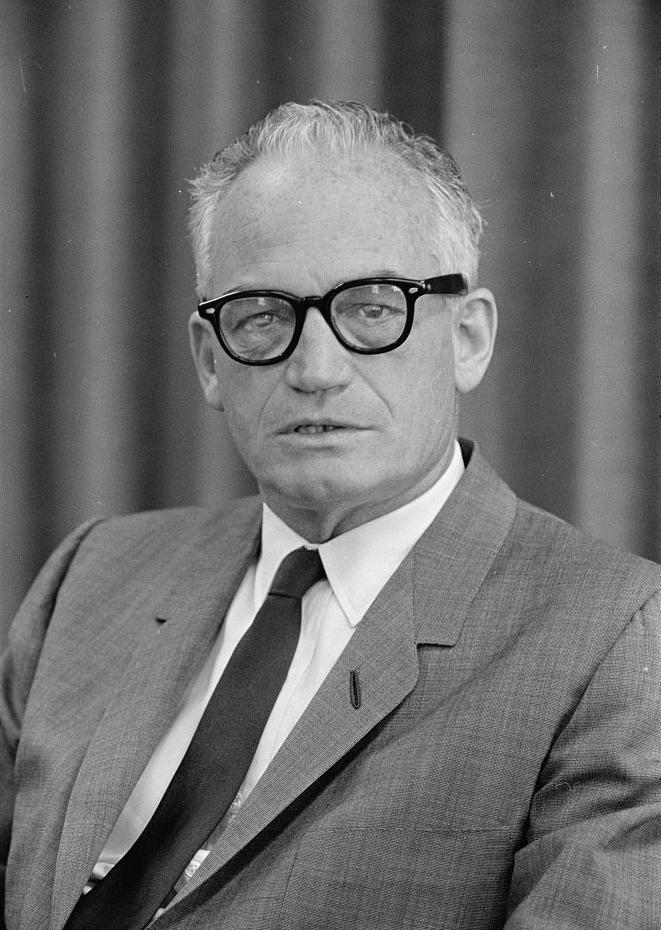
In the year of my conception, 1964, another Donald Trump threatened to wreck not only the GOP, but the republic itself: Barry Goldwater. goldwater

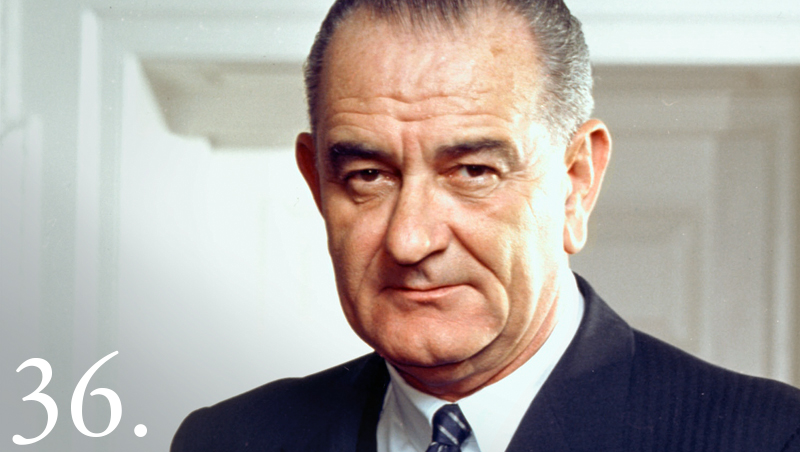
Consider Barry Morris Goldwater Trump beta: also a Republican, a businessman, rich and nasty as hell. Like Trump, he despised what America had become. Namely, less white. He would earn his fame by filibustering and voting against the Voting Rights Act — and taking a shellacking in the presidential race by a guy who wasn’t even sure he wanted the job. lyndon

As Trump will in a month.

This will likely come naturally, as the Donald and his ilk choke on his own vitriolic bile. But just in case, all historians and the Clinton campaign need do is look at the Democratic advertising strategy of Lyndon Johnson. Like Clinton, he was ahead in the polls.

But there is an important stratagem here in Johnson for Clinton: Don’t take your foot off an opponent’s neck.  Johnson, for instance, was worried of an 11th hour rally and, not wanting to risk a GOP resurrection, sprang an attack campaign that created the modern template of American politics.

Johnson approved “Daisy Girl,” one of the most terrifying and effective political ads in political history. Sure, it was alarmist, sensational, and had no real basis in fact.

But at least it kept a nut from learning the nuclear ATM passcode.

Clinton would be well-served to follow Johnson’s lead. While her lead in polls (if they can be trusted; who under 40 even uses a home phone?), now is the time to break into the Secretariat Stretch, finishing off the Republican Party as it lurches in Tea Party/Trumpian death throes spasms.

Maybe she could even find this guy, if he’s not dead from cancer. The parallels are frightening. He even kind of looks like Trump, if a world away in logic. But it would be a kick to Trump’s slats, which is apparently the only place Donald can feel.

No one enjoys negative ads.

But it’s a lot better than negative nuts.


I’ve always been a sucker for gadgets, gizmos and whatzits.

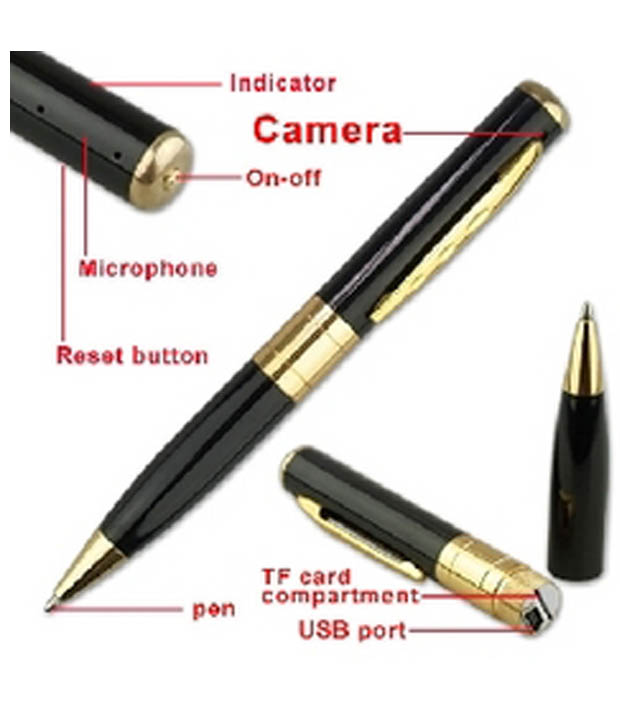
Perhaps it was the gimmicks in the cheap magic tricks I bought as a kid. At least that’s what I rationalize when I continue to feed my addiction to odd purchases. Like the spy pen camera I bought I last week.

I had no need for one, as I’ve really cut down on my pen writing and spying. I can’t even really tell you why I was looking at them. But I knew when I wanted one: When one reviewer who raved about the device admitted that he bought it it “because when I was a kid I always dreamed of having one.”

spy-pen

That’s enough for me (along with a price tag of $35; funny, the cost of dreams). Alas, the toy was broken upon arrival, and I had to reluctantly return it.

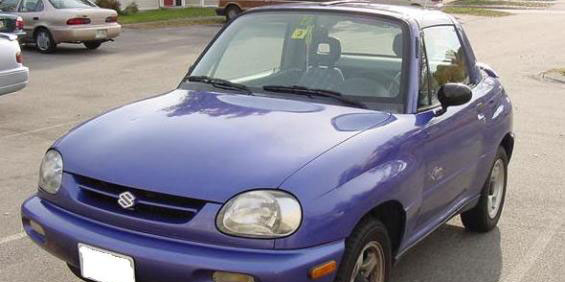
The psychosis spreads to my vehicles, many of which will become historical footnotes of bad engineering. There were the two Fieros. The Yugo. And one of my favorites, a purple X-90 that’s the closest the auto industry has come to a bubble car. x90 I’m currently driving a smart car because the Fiat 500 seemed too big, having a backseat and all.

I drive another ridiculous contraption now, a Can-Am Spyder that is, in essence, a reverse trike — two wheels in front, one in back. Think a dyslexic Big Wheel. The bike flummoxes insurance companies and state DMVs, which aren’t sure how to categorize it. You don’t even need a motorcycle license to drive one, which is about as insane as not needing a license to work an AR-15.

But the gizmo has turned into an intellectual whatzit. The purchase was borne of the stubborn realization that driving on only two wheels is insane in Los Angeles. But I can’t bring myself to give up the roller-coaster high that is any motorcycle ride.

So now I drive the equivalent of either a Batbike or a bike for circus clowns, and love it. I take 6-mile rides along Lake Balboa to pick up a donut three blocks away. The thing has such a cavernous trunk I take it grocery shopping, as it can hold a 24-pack and two grocery bags. It’s the first motorcycle to earn a thumbs-up from my mother, which is either a very good or very troubling sign.

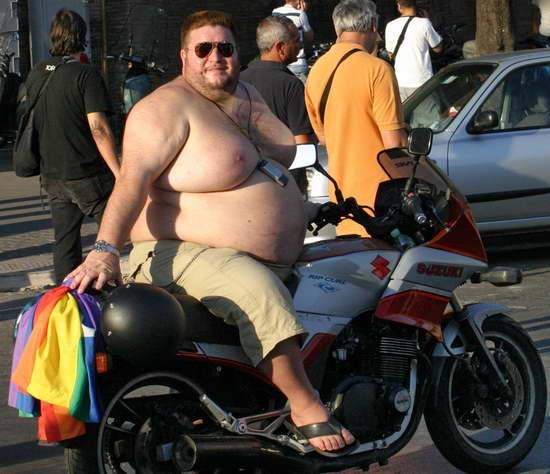
It has come at the cost of some hubris. Once I rode a Harley, and I’m still too embarrassed by the training wheels to pull into a Harley shop, lest I be discovered for the fraud I am.

biker-wannabe

But there’s something to that third wheel, more assuring than I expected. A good friend recently confided he rides his Harley now to simply keep it running. “But it’s a 700 pound bike,” he told me. “If that drops, I won’t be able to pick it up.”

I hear you, brother. And I’m only a half step behind you in my burgeoning caution.

But on the ride to buy cake donuts this weekend, I came upon a group of boys, all brandishing skateboards and spasming cell phones. They geared up, headed out of the shop, and surrounded the bike. “What the hell is that?” one asked loudly to no one.

And I realized: He’d found the through line to much of my life. From magic tricks to handheld gadgets to the motorcycles and cars that ferry me, I’m undeniably drawn to any whatthehellisthat?

Fortuna may insist that my body age. But she is powerless against my towering immaturity.

Nyah Nyah Nyah.

Now what’s that spy pen website?