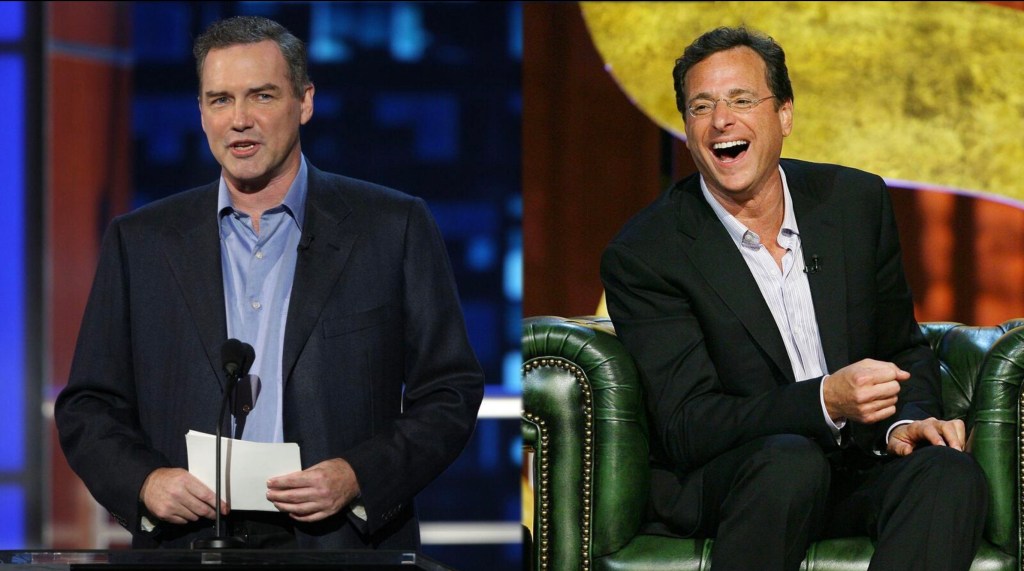
Norm Macdonald could make kindness a punchline..
Netflix’s terrific “Norm: The Tale of Norm Macdonald” reminds us how much intelligence that required.
Judd Apatow’s documentary began streaming October 16, alongside the theatrical release of Nathan Fielder and Lance Oppenheim’s Elizabeth Holmes documentary, “You Can See Everything.” Anyone seeking another encounter with a master of misdirection can skip the ticket line.
Macdonald was an accessible Andy Kaufman. Just as brilliant. Perhaps more so.
Kaufman could turn bewilderment into an endurance test. Macdonald made it feel like company. You wanted to stay with him even when he seemed determined to lose you.
Apatow gives that tension room to work. Drawing on archival footage and home videos, he lets us experience the peculiar pleasure of watching an audience struggle to catch up. Macdonald’s confidence could make everyone else look nervous.
Consider Comedy Central’s 2008 roast of Bob Saget. The format rewards aggression. Each comedian must find something more appalling to say than the last. Macdonald recognized how predictable that supposedly outrageous ritual had become.
So he brought dad jokes. His father had given him a book of retirement-party jokes when he started in comedy. Macdonald later told Marc Maron he used it for the roast. A producer instructed him to be shocking.
So he was anything but. The gags creaked. Macdonald lingered over them. You could feel the uncertainty: Had he lost his touch? Had he misunderstood the assignment?
Watching now, the performance is hilarious. He turned the roast’s appetite for humiliation back on the roast. The room had prepared for cruelty; sincerity left it defenseless.
His affection for Saget gave the joke its force. He could make fun of the occasion while honoring the friend.
Television kept giving Macdonald shows, though his best work often came from taking over somebody else’s. He could make a host’s loss of control the evening’s chief pleasure. His own vehicles, from ABC’s “The Norm Show” to Netflix’s “Norm Macdonald Has a Show,” faced the problem of containing a performer whose appeal lay in escaping containment.
His 2016 book, “Based on a True Story,” extended the mischief: offer readers a memoir, then let them wonder how much of the author they could believe.
Twitter accommodated the same wandering intelligence. His account of “Saturday Night Live’s” 40th-anniversary special ran to 110 tweets. Readers followed because he made the detours worth taking.
Macdonald died September 14, 2021, at 61, after keeping cancer private for nine years. Producing partner Lori Jo Hoekstra said he wanted audiences and loved ones to keep seeing him as they always had.
The roast preceded his illness. The book and later shows came during treatment.
Kaufman sought a cancer cure in the Philippines through purported psychic surgery before his death in 1984. Macdonald kept his struggle largely beyond public view.
It gives the later performances an ache. Apatow trusts the comedy to bear it.
Macdonald spent his career making us wonder what he meant. He left us knowing how much he mattered.

